1. Introduction
The Philippine archipelago exhibits remarkable climatic diversity despite lying entirely within the tropical zone. Differences in elevation, proximity to the sea, exposure to prevailing winds, and regional rainfall patterns create environmental conditions that vary considerably from one location to another.
While the preceding publication (QRS-050) introduced the Köppen-Geiger Climate Classification as a framework for understanding Philippine climates, this publication applies that framework to twenty representative locations selected from across the country. Together, these locations illustrate the range of environmental conditions that architects are likely to encounter in professional practice.
Rather than presenting climate as abstract scientific data, the objective is to demonstrate how local climatic conditions influence architectural decision-making. By comparing representative locations, designers gain a clearer understanding of how building orientation, ventilation, shading, moisture control, and material selection should respond to the environmental characteristics of each project site.
Every project site possesses its own climatic character, even within the same country.
Understanding representative locations enables architects to develop design solutions that respond to local environmental conditions rather than relying on generalized assumptions about tropical architecture.
2. Why Representative Locations Matter
Although climate classification provides a valuable overview of regional environmental conditions, architects rarely design for climate zones alone. Every building is constructed on a specific site with its own combination of temperature, rainfall, humidity, solar exposure, wind characteristics, and topographical influences.
For this reason, the study examines twenty representative Philippine locations distributed among the country's five Köppen-Geiger climate classifications. Each location serves as a practical example of the environmental conditions associated with its respective climate type, enabling architects to relate regional climate classifications to actual project locations.
Rather than attempting to document every municipality in the Philippines, representative locations provide a manageable framework for comparing environmental conditions and identifying the architectural strategies most appropriate to each climatic setting
3. Organization of This Study
The twenty representative locations are organized according to the five Köppen-Geiger climate classifications identified in the previous publication. Four locations have been selected to represent each climate type, providing a balanced overview of climatic variation throughout the Philippines.
Each location includes a consistent set of environmental information, including:
- Geographic location
- Climate summary
- Monthly temperature
- Solar conditions
- Daylight availability
- Wind characteristics
- Rainfall distribution
- Relative humidity
- Climate graphs
- Monthly weather tables
Presenting each location using the same analytical framework allows meaningful comparisons between regions while maintaining consistency throughout the publication.
4. Understanding the Climate Profiles
Each climate profile should be interpreted as a comprehensive environmental description rather than a collection of isolated weather statistics.
Average temperatures indicate likely thermal conditions throughout the year, while rainfall graphs reveal seasonal moisture patterns that influence roof design, drainage, and building durability. Wind roses identify prevailing wind directions that support natural ventilation strategies, and daylight information assists in evaluating solar access and daylight availability.
Viewed together, these environmental indicators provide architects with a practical basis for developing climate-responsive design strategies tailored to each project location.
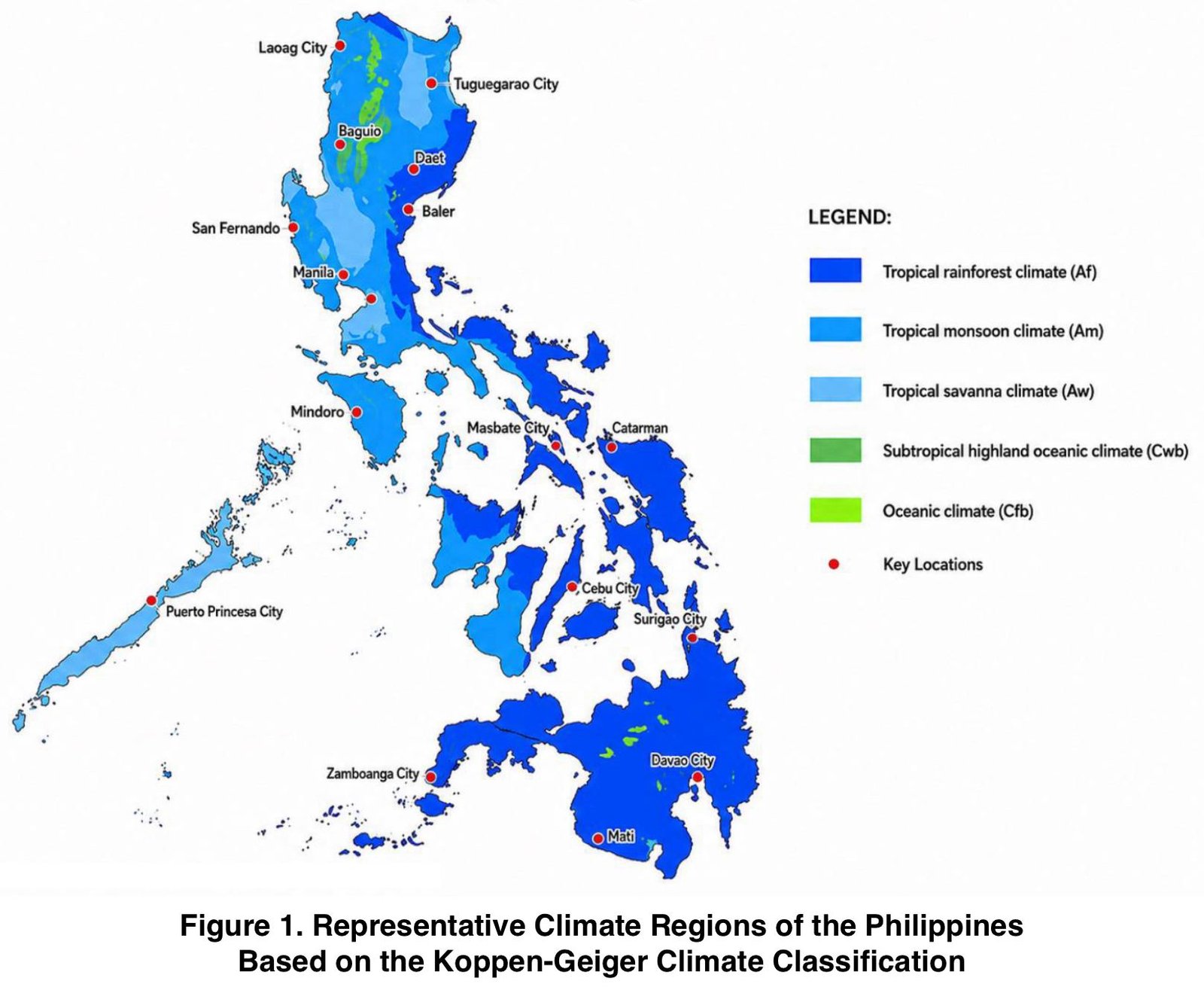
Figure 1 illustrates the geographical framework upon which this publication is organized. Rather than attempting to document every municipality in the Philippines, the study focuses on twenty representative locations selected to reflect the country's principal climate classifications. Together, these locations provide architects with a practical reference for understanding how regional climatic differences influence building design.
Each representative location has been analyzed using a consistent set of environmental indicators, including monthly temperature, rainfall distribution, prevailing wind conditions, solar geometry, daylight availability, humidity, and other climatic variables. Applying a common analytical framework allows meaningful comparisons between regions while highlighting the environmental factors that most directly influence architectural decision-making.
The following sections examine each climate group individually. Rather than treating climate as an abstract scientific classification, the discussion emphasizes its practical implications for building orientation, passive cooling, daylighting, moisture management, material durability, and overall climate-responsive design.
5. Tropical Rainforest Climate (Af)
The Tropical Rainforest Climate is characterized by abundant rainfall throughout the year, consistently warm temperatures, and relatively small seasonal variations. High humidity and persistent cloud cover are common, while rainfall is generally distributed across all twelve months with no pronounced dry season.
For architects, these conditions emphasize the importance of maximizing natural ventilation, protecting buildings from continuous moisture exposure, minimizing solar heat gain, and selecting durable materials capable of resisting prolonged humidity.
The following representative locations illustrate this climate type within the Philippine context.
- Baler
- Catarman
- Surigao City
- Davao City
Buildings in Tropical Rainforest climates should prioritize continuous natural ventilation, generous roof overhangs, durable moisture-resistant materials, and effective rainwater management. High annual humidity demands careful detailing to prevent mold, corrosion, and premature material deterioration, while passive cooling strategies help maintain occupant comfort with minimal energy use.
6. Tropical Monsoon Climate (Am)
The Tropical Monsoon Climate experiences abundant annual rainfall accompanied by a relatively short dry season. Although temperatures remain uniformly warm, rainfall patterns are strongly influenced by seasonal monsoon systems, producing marked differences between wetter and drier months.
Buildings designed for this climate must accommodate both prolonged wet conditions and periods of intense solar exposure. Roof drainage, moisture protection, shading devices, and natural ventilation all become important components of climate-responsive architectural design.
Representative Philippine locations include:
- Cebu City
- Tanay
- Mabalacat
- Masbate City
Architectural design should respond to distinct wet and dry seasons by combining effective rain protection with strategies for natural ventilation during warmer months. Roof drainage, covered outdoor spaces, moisture-resistant detailing, and adaptable shading devices become essential components of climate-responsive buildings.
7. Tropical Savanna Climate (Aw)
The Tropical Savanna Climate is distinguished by a clearly defined dry season followed by a wetter summer period. Solar radiation is generally more intense during the dry months, increasing cooling demands while reducing the availability of naturally cooled outdoor environments.
Architectural responses emphasize passive solar protection, landscape planning, water conservation, and natural ventilation. Proper orientation and external shading can substantially reduce cooling loads while improving occupant comfort.
Representative locations within this category demonstrate the diversity of conditions that may exist despite sharing the same overall climate classification.
- Laoag
- Manila
- Puerto Princesa
- Tuguegarao
Buildings in Tropical Savanna regions should emphasize protection from intense solar radiation while maximizing natural airflow. Proper building orientation, external shading, thermal mass, landscape planning, and water-efficient design strategies contribute to improved comfort and reduced cooling requirements during extended dry periods.
8. Subtropical Highland Climate (Cwb)
High-elevation environments create climatic conditions that differ markedly from those experienced in surrounding lowland regions. Cooler temperatures, greater diurnal temperature variation, and increased cloud formation contribute to a more moderate thermal environment.
Architectural priorities shift accordingly. Buildings generally require less mechanical cooling but greater attention to passive solar access, moisture management, and protection from prevailing mountain winds.
Representative Philippine locations include:
- Baguio City
- Sagada
- Diadi
- La Trinidad
Highland environments offer naturally cooler temperatures, allowing architects to minimize mechanical cooling while emphasizing daylighting, passive solar heating during cooler months, and protection from prevailing mountain winds. Building envelopes should respond to greater daily temperature variation than is typical in the lowlands.
9. Oceanic Climate (Cfb)
The Oceanic Climate is the least common climate classification represented in the Philippines and occurs only in a limited number of high-altitude environments. Temperatures remain comparatively mild throughout the year, while rainfall is generally well distributed and humidity remains consistently high.
Although geographically limited, these locations illustrate how elevation can fundamentally modify tropical climatic conditions. Their environmental characteristics often require architectural responses more closely associated with temperate mountain regions than with the tropical lowlands surrounding them.
Representative Philippine locations include:
- Dagdag
- Malisbong
- Tinoc
- Makingking
Although uncommon in the Philippines, Oceanic climates demonstrate how elevation can significantly moderate tropical conditions. Architectural responses should maximize daylight, maintain thermal comfort through natural ventilation, and carefully manage moisture while taking advantage of the cooler ambient temperatures.
10. Conclusion
The twenty representative locations presented in this publication demonstrate that climate-responsive architecture cannot rely upon generalized assumptions about tropical design. Significant environmental differences exist across the Philippine archipelago, and these variations influence nearly every aspect of building performance.
By examining representative locations within each Köppen-Geiger climate classification, architects gain a practical understanding of how local climatic conditions affect building orientation, ventilation, daylighting, moisture control, and energy performance. Climate classification therefore becomes far more than a descriptive scientific tool—it becomes a practical design resource that supports informed architectural decision-making.
Together with the preceding publication on Philippine climate classification, this guide establishes the environmental foundation upon which the remaining publications in the QuidErgo Research Series will build. Subsequent volumes will demonstrate how these climatic insights can be translated into passive design strategies, environmental simulation, and ultimately the realization of high-performance and Net Zero Buildings.
Readers are strongly encouraged to download the accompanying PDF edition after completing this online Research Page. The web version is intended as an accessible introduction to the research, while the downloadable PDF remains the complete and authoritative publication, preserving the full discussion, illustrations, references, and supporting material presented in the original study. Both formats are designed to complement each another and provide the most rewarding learning experience.
References
-
Peel, M. C., Finlayson, B. L., & McMahon, T. A. (2007).
Updated World Map of the Köppen-Geiger Climate Classification.
Hydrology and Earth System Sciences.
Provides the internationally recognized Köppen-Geiger climate classification system adopted throughout this publication. -
Szokolay, S. V. (2014).
Introduction to Architectural Science: The Basis of Sustainable
Design
(3rd ed.). Routledge.
Explains the scientific relationship between climate, thermal comfort, solar geometry, and architectural design that forms the analytical basis for evaluating representative Philippine locations. -
Philippine Atmospheric, Geophysical and Astronomical Services Administration
(PAGASA). Climate of the Philippines.
Official Philippine source for climate statistics, weather observations, rainfall distribution, monsoon systems, and regional climatological data. -
Brown, G. Z., & DeKay, M. (2014).
Sun, Wind & Light: Architectural Design Strategies (3rd ed.).
John Wiley & Sons.
Provides comprehensive climate-responsive architectural design principles and passive environmental strategies applicable to the climatic conditions presented in this publication. -
Köppen, W. Climatology: A Study of Climates of the Earth.
Foundational work establishing the climate classification framework upon which the modern Köppen-Geiger system is based. -
Philippine Green Building Council (PhilGBC).
BERDE Green Building Rating System.
Provides the Philippine sustainability framework supporting climate-responsive architectural and environmental design. -
Chan, R. G. (2026).
Climate Classification: Philippines (QRS-050). QuidErgo Research
Series.
Establishes the national climatic framework that is expanded in this publication through representative Philippine locations.
Suggested Citation
If you wish to reference this publication, please cite it as:
Chan, R. G. (2026). Climate Classification: Key Locations. QuidErgo Research Series (QRS-060). RG Chan & Associates. https://quidergo.com/
Available Download
The original publication associated with this research paper is available for download below. It forms part of the historical Net Zero Buildings (NZB) research archive upon which the QuidErgo Research Series is based.
Original Net Zero Buildings (NZB) research paper presenting the Köppen–Geiger climate analysis of selected key locations in the Philippines, demonstrating how regional climatic variations influence climate-responsive architectural design strategies and site-specific planning decisions.
A Note on Sources
This publication combines internationally recognized climatological references with original architectural research developed by RG Chan & Associates. While internationally accepted climate classification systems provide the scientific foundation, the selection of representative Philippine locations, climatic interpretation, and architectural design recommendations presented herein reflect the author's professional application of environmental analysis to climate-responsive architecture within the Philippine context.
Continue Exploring
Next Publication:
QRS-070 →Climate-Responsive Design Strategies
Discover how sun, wind, rain, and daylight become the four primary environmental forces that shape climate-responsive architectural design, introducing the SWRL methodology that forms the foundation of the succeeding QuidErgo Research Series publications.