Executive Summary
This publication introduces the QuidErgo Research Series (QRS), a curated collection of research publications on climate-responsive architecture and Net Zero Buildings in the Philippines. It establishes the research objectives, methodology, terminology, and organizational framework that unite the publications comprising this Research Series.
Rather than presenting a single technical paper, this publication serves as the Prolegomenon to the Research Series. Together, the publications provide architects, planners, engineers, students, developers, and building owners with practical knowledge for designing climate-responsive and environmentally responsible buildings in the Philippine context.
The Research Series emphasizes that achieving high environmental performance requires more than selecting individual sustainable technologies. It advocates an integrated architectural approach that combines climate-responsive design, building science, renewable energy, environmental analysis, and sound professional judgment to create buildings that perform better, consume less energy, and provide lasting value.
Background and Rationale
Global interest in Net Zero Buildings has accelerated rapidly over the past decade. While numerous international publications discuss sustainable architecture and building performance, relatively few address the unique climatic, economic, and regulatory conditions found in the Philippines.
Design strategies developed for temperate climates cannot always be applied directly to tropical environments. Successful Net Zero Buildings require design solutions that respond to local climate, available technologies, construction practices, building regulations, and economic realities.
Recognizing this need, RG Chan & Associates initiated this research program to develop a practical framework for climate-responsive architectural design in the Philippine setting. Rather than merely adopting overseas standards, the objective has been to establish design principles that integrate internationally recognized best practices with local environmental conditions and professional experience.
Rather than presenting a single research paper, this publication serves as the introduction to the QuidErgo Research Series. Collectively, the publications document the progression from environmental principles and climate analysis to architectural design strategies, case studies, and practical applications, providing a coherent body of knowledge for architects, planners, engineers, students, developers, and building owners.
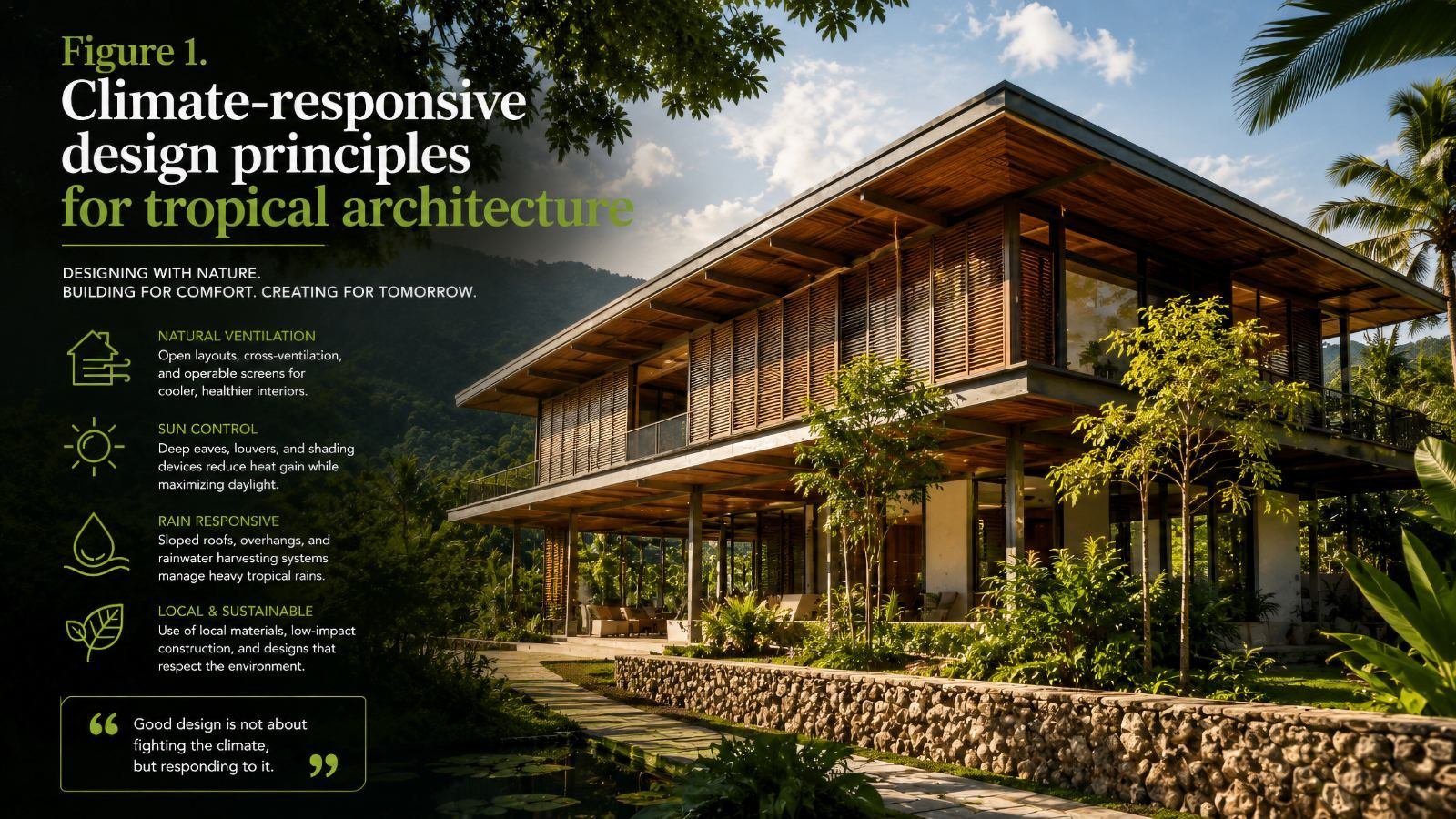
Net Zero is not a design style—it is a climate-responsive design methodology that integrates environmental understanding, architectural judgment, and appropriate technology.
Its goal is to create buildings that consume less energy, perform better, provide greater occupant comfort, and last longer.
Understanding Net Zero Buildings
A Net Zero Building (NZB) is generally defined as a building that produces as much energy from renewable sources as it consumes over the course of a year. Although definitions vary among organizations and certification systems, the common objective is to reduce environmental impact while providing healthy, comfortable, and efficient spaces for occupants.
Achieving Net Zero performance involves more than incorporating renewable energy technologies such as solar photovoltaic systems. It begins with sound architectural planning, including appropriate site selection, building orientation, climate-responsive design, daylighting, natural ventilation, efficient building envelopes, and the thoughtful integration of passive and active environmental strategies.
Throughout the QuidErgo Research Series, Net Zero Buildings are viewed not simply as an energy target, but as the result of informed architectural decisions made throughout the design process. Environmental performance is therefore regarded as an outcome of good planning rather than an objective achieved solely through technology.
Various organizations have developed rating systems to measure and recognize different levels of building performance. The following section introduces several of the most widely adopted international systems before examining their application within the Philippine context.
Net Zero Building Ratings
As sustainable building practices have evolved, numerous organizations have developed certification systems to evaluate and recognize high-performance buildings. Although these rating systems differ in methodology, they generally assess a building's environmental performance using a combination of criteria that include energy efficiency, water conservation, indoor environmental quality, materials, site sustainability, and operational performance.
Building rating systems provide a common framework for measuring sustainability, benchmarking performance, and encouraging continuous improvement throughout the design, construction, and operation of buildings. They have also helped establish internationally recognized standards for environmentally responsible development.
The following sections provide a brief overview of several widely recognized international rating systems before examining the Philippine Green Building Council's BERDE rating system, which has been developed specifically for local climatic, regulatory, and construction conditions.
International Rating Systems
Several countries and organizations have developed building rating systems to encourage sustainable design and recognize high-performing buildings. While each system uses its own methodology and performance criteria, all share the common objective of reducing environmental impact and improving the quality, efficiency, and resilience of the built environment.
Among the most widely recognized are the Leadership in Energy and Environmental Design (LEED) developed by the U.S. Green Building Council (USGBC), the Building Research Establishment Environmental Assessment Method (BREEAM) of the United Kingdom, Singapore's Green Mark Scheme, Australia's Green Star Rating System, and the Living Building Challenge (LBC). These frameworks have significantly influenced sustainable building practices worldwide and have provided valuable references for many national green building initiatives.
While these international rating systems have advanced sustainable design globally, individual countries often develop their own certification systems to address local climatic conditions, construction practices, regulatory requirements, and environmental priorities. In the Philippines, this role is fulfilled by the BERDE Green Building Rating System developed by the Philippine Green Building Council.
Net Zero Building Ratings in the Philippines
In the Philippines, the Philippine Green Building Council (PhilGBC) developed the Building for Ecologically Responsive Design Excellence (BERDE) Green Building Rating System to provide a nationally recognized framework for evaluating the environmental performance of buildings. BERDE responds specifically to Philippine climatic conditions, construction practices, regulatory requirements, and sustainability priorities while remaining consistent with internationally recognized green building principles.
BERDE evaluates buildings using a comprehensive set of performance criteria that extends beyond energy efficiency. The system recognizes projects that demonstrate excellence in site sustainability, energy and water efficiency, materials, indoor environmental quality, construction management, emissions reduction, and innovation, encouraging an integrated approach to sustainable design.
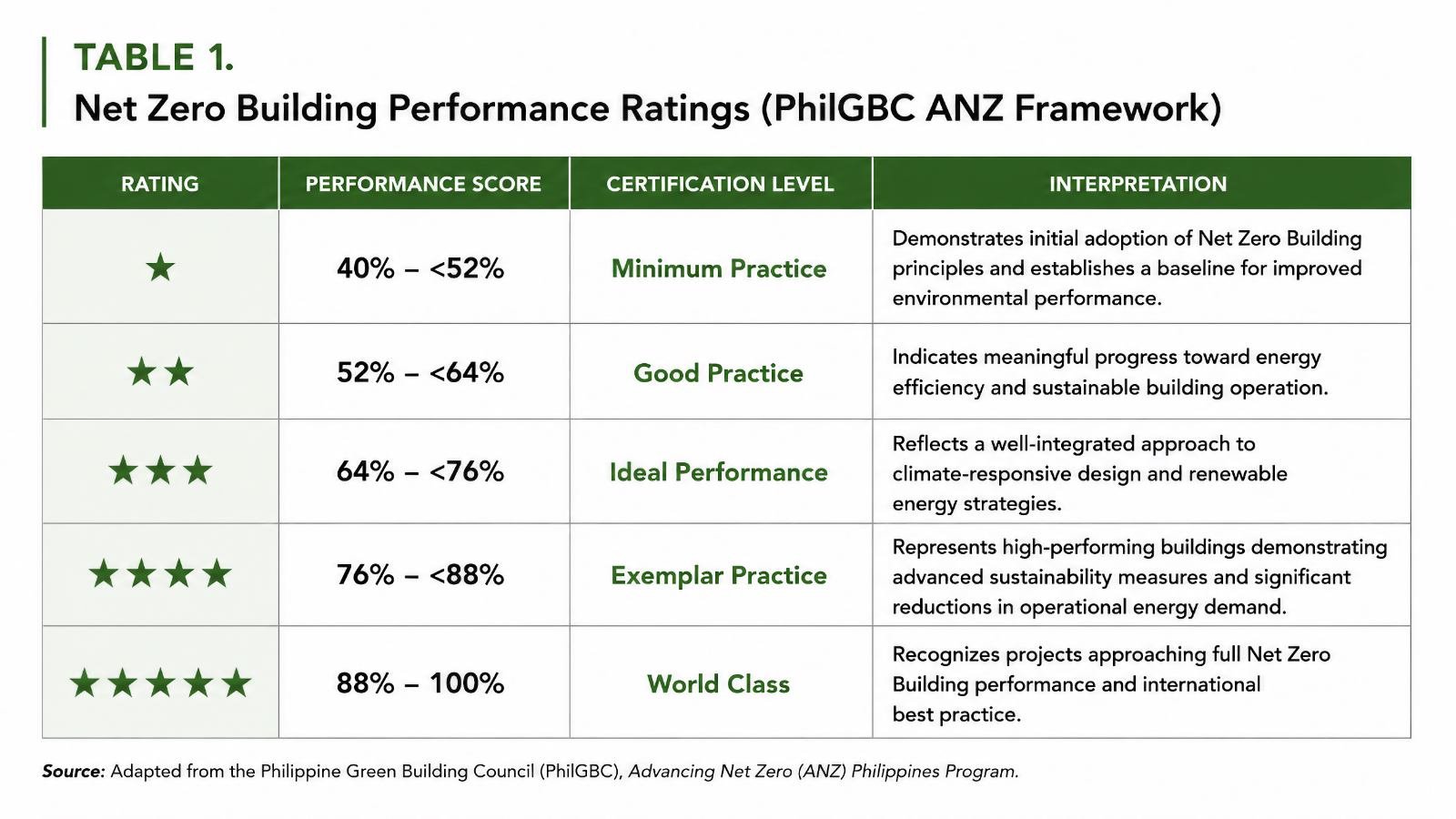
Table 1 summarizes the principal BERDE assessment categories and illustrates the broad range of considerations involved in achieving environmentally responsible building performance.
Can Net Zero Buildings Be Affordable?
One of the most common misconceptions about Net Zero Buildings is that they are inherently expensive. While some projects incorporate advanced technologies that increase initial construction costs, achieving high environmental performance does not necessarily require a substantially larger budget. Many of the most effective sustainability strategies are the result of sound architectural planning rather than costly building systems.
Climate-responsive design, appropriate building orientation, efficient space planning, daylighting, natural ventilation, and well-designed building envelopes can significantly reduce energy demand before renewable energy systems are considered. These passive design strategies often improve building performance while adding little or no additional construction cost when incorporated during the early stages of design.
Although certain sustainable technologies may increase initial capital investment, they can produce substantial long-term savings through lower operating costs, reduced maintenance, improved occupant comfort, and greater building durability. Evaluating a building solely on its first cost may therefore overlook the broader economic and environmental benefits realized throughout its service life.
The objective of this Research Series is not to promote expensive technologies, but to demonstrate how informed architectural decisions and integrated design strategies can achieve high levels of environmental performance while remaining practical, appropriate, and economically responsible within the Philippine context.
Research Objectives
The QuidErgo Research Series was developed to promote a deeper understanding of climate-responsive architecture and Net Zero Buildings within the Philippine context. Its principal objectives are to:
- present the fundamental principles of climate-responsive and environmentally responsible architectural design;
- demonstrate practical strategies for improving building performance while reducing energy demand;
- encourage the integration of passive design, renewable energy, and sustainable technologies through sound architectural planning;
- provide architects, planners, engineers, students, developers, and building owners with practical and locally relevant reference material; and
- contribute to the continuing development of sustainable architecture in the Philippines.
Collectively, the publications in this Research Series present a practical body of knowledge that bridges architectural theory and professional practice, emphasizing solutions that are technically sound, environmentally responsible, and economically appropriate.
Organization of the Research Series
The QuidErgo Research Series is organized as a sequence of complementary publications that examine climate-responsive architecture and Net Zero Buildings from both theoretical and practical perspectives. Each publication addresses a specific topic while contributing to a coherent body of knowledge that progresses from fundamental concepts to architectural applications and professional practice.
Together, the publications are intended to be read either individually or as an integrated reference for architects, planners, engineers, students, developers, and building owners seeking practical guidance for sustainable design in the Philippine context.
| Publication | Focus |
|---|---|
| QRS-010 | Executive Summary |
| QRS-020 | Exploratory Analysis |
| QRS-030 | Technical Manual: Ecotect (Internal) |
| QRS-040 | Training Course: Ecotect (Internal) |
| QRS-050 | Climate Classification: Philippines |
| QRS-060 | Climate Classification: Key Locations |
| QRS-070 | Climate-Responsive Design Strategies |
| QRS-080 | San Marino: Architectural Design Program |
| QRS-090 | San Marino: Scheme A |
| QRS-100 | San Marino: Scheme B |
| QRS-110 | San Marino: Scheme C |
| QRS-120 | UC Campo Libertad |
Research Legacy
The QuidErgo Research Series represents the culmination of several years of research, professional practice, and continuing study in climate-responsive architecture and Net Zero Buildings. Although each publication addresses a specific aspect of sustainable design, the collection is intended to function as an integrated body of knowledge that combines environmental science, architectural methodology, and practical application.
The Research Series does not seek to prescribe a single design solution. Rather, it encourages architects and design professionals to understand the environmental forces that shape buildings and to respond with solutions that are appropriate to climate, place, function, available technology, and economic realities.
As sustainability standards, building technologies, and environmental challenges continue to evolve, the principles presented throughout these publications should likewise be viewed as a foundation for continuing professional learning and responsible architectural practice.
Conclusion
Climate-responsive architecture and Net Zero Buildings are not defined by a single technology or certification system, but by an integrated design approach that balances environmental responsibility, building performance, occupant well-being, and economic practicality.
The QuidErgo Research Series has been developed to demonstrate that sustainable design is achieved through informed architectural decisions made throughout the planning and design process. By combining scientific research, professional experience, and practical application, the publications seek to provide architects, planners, engineers, students, developers, and building owners with a useful reference for designing environmentally responsible buildings in the Philippine context.
It is hoped that this Research Series will contribute to the continuing advancement of sustainable architecture by encouraging thoughtful, climate-responsive, and professionally responsible design for future generations.
Our Net Zero Building Research Study for the UC Campo Libertad proposal represented an opportunity to apply the same evidence-based methodology to a significantly larger institutional development. Our analytical evaluation indicated that the proposed design could potentially achieve an overall Net Zero Building rating of approximately 78% (Exemplar Practice)—a level of environmental performance that, if realized, would have positioned the University of the Cordilleras as a pioneer in sustainable campus development and could have become the first documented Net Zero Building project in Baguio City.
RG Chan & Associates remains deeply disappointed that we were not given the opportunity to fully present and explain the environmental analysis underlying our proposal before the final selection was made. While we respect the University's right to determine its preferred project delivery approach, we believe that greater transparency regarding the evaluation process would have benefited all participating proponents and strengthened confidence in the outcome.
We sincerely hope that the University will continue to pursue high-performance, climate-responsive architecture and that future procurement processes will provide adequate opportunities for competing design teams to present the full merits of their proposals.
Readers are strongly encouraged to download the accompanying PDF edition after completing this online Research Page. The web version is intended as an accessible introduction to the research, while the downloadable PDF remains the complete and authoritative publication, preserving the full discussion, illustrations, references, and supporting material presented in the original study. Both formats are designed to complement each another and provide the most rewarding learning experience.
References
-
Brown, G. Z., & DeKay, M. (2014).
Sun, Wind & Light: Architectural Design Strategies (3rd ed.).
John Wiley & Sons.
Principal reference for climate-responsive architectural design strategies and environmental analysis methodologies. -
Szokolay, S. V. (2014).
Introduction to Architectural Science: The Basis of Sustainable
Design
(3rd ed.). Routledge.
Provides the scientific principles of architectural science, environmental physics, and sustainable building design that underpin climate-responsive architecture. -
Philippine Green Building Council (PhilGBC).
BERDE Green Building Rating System.
The national green building rating system used in the Philippines for evaluating sustainable building performance. -
World Green Building Council (WorldGBC). Advancing Net Zero.
International framework promoting the transition toward Net Zero Carbon Buildings worldwide. -
Building Science Corporation. Building Science Digest Series.
Technical articles and research papers on building envelopes, moisture management, thermal performance, and environmental control. -
Straube, J. (2011).
Building Science Digest 013: Rain Control in Buildings. Building
Science Corporation.
Technical reference on rain management and moisture control in building envelopes. -
Blankenbehler, B. (2015).
Principles of Rain Drainage in Architecture.
Reference article discussing rainwater management as an integral component of sustainable architectural design. -
Wikipedia Contributors. Zero-energy building.
General reference providing historical background, terminology, and international definitions related to Net Zero Buildings. -
Wikipedia Contributors. Sustainable Development.
General reference describing the evolution of sustainable development concepts and terminology.
Suggested Citation
If you wish to reference this publication, please cite it as:
Chan, R. G. (2026). Prolegomenon: Executive Summary. QuidErgo Research Series (QRS-010). RG Chan & Associates. https://quidergo.com/
Available Download
The original publication associated with this research paper is available for download below. It forms part of the historical Net Zero Buildings (NZB) research archive upon which the QuidErgo Research Series is based.
Original Net Zero Buildings (NZB) research paper prepared as the introductory publication to the SWRL (Sun, Wind, Rain, and Light) research program.
A Note on Sources
This publication combines internationally recognized references on climate-responsive architecture, sustainable building design, building science, and Net Zero Buildings with original research and professional synthesis developed by RG Chan & Associates. While the cited publications provide the theoretical foundations, methodologies, and technical references discussed throughout this Research Series, the Philippine case studies and practical applications represent the author's own professional experience and continuing research in climate-responsive architectural design.
Continue Exploring
Next Publication:
QRS-020 →Exploratory Report
Discover how environmental simulation software was evaluated for practical application in climate-responsive architectural design, establishing the analytical foundation for the research publications that follow.