- Introduction
- Understanding the Köppen-Geiger System
- Climate Classification in the Philippines
- The Five Philippine Climate Types
- Architectural Design Implications
- Regional Climate Distribution
- Using Climate Data in Design
- Limitations and Practical Considerations
- Lessons for Philippine Practice
- Conclusion
- References
Introduction
The design of climate-responsive buildings begins with an understanding of climate itself. Before architects determine building orientation, select materials, size roof overhangs, or evaluate natural ventilation strategies, they must first understand the environmental conditions unique to the project site.
Although the Philippines is generally regarded as having a tropical climate, the country's diverse geography creates significant climatic variations. Mountain ranges, coastal conditions, elevation, seasonal monsoons, and regional rainfall patterns produce distinct environmental characteristics that directly influence architectural performance.
This publication introduces the Köppen-Geiger Climate Classification System as a practical framework for understanding Philippine climatic diversity. Rather than treating climate as background information, the study presents it as one of the primary design parameters for achieving climate-responsive and Net Zero Building design.
Climate is the architect's first design constraint, not an afterthought.
Understanding local climate allows every subsequent design decision to become more efficient, sustainable, and responsive to its environment.
2. Understanding the Köppen-Geiger Climate Classification
The Köppen-Geiger Climate Classification is one of the world's most widely recognized systems for categorizing climates. Originally developed by German climatologist Wladimir Köppen and later refined by Rudolf Geiger, the system classifies climates according to long-term patterns of temperature and precipitation.
Unlike simple weather observations, which describe short-term atmospheric conditions, the Köppen-Geiger system identifies the prevailing climate characteristics that influence ecosystems, vegetation, agriculture, and ultimately the built environment.
Because vegetation naturally adapts to local climatic conditions, Köppen recognized that climate and plant distribution are closely related. This relationship makes the classification especially useful for architects, planners, and environmental designers seeking to understand how buildings should respond to their surroundings.
Today, the Köppen-Geiger classification remains one of the most widely adopted references in environmental planning, geographic studies, and climate-responsive architectural design.
3. Climate Classification in the Philippines
The Philippine archipelago extends from approximately 5° to 21° north latitude and consists of more than 7,000 islands surrounded by the Pacific Ocean, the Philippine Sea, the South China Sea, and the Sulu Sea. Elevations range from sea level to nearly 3,000 meters above sea level at Mount Apo.
Although the country lies entirely within the tropics, differences in elevation, topography, exposure to prevailing winds, and seasonal rainfall create several distinct climatic regions. These climatic differences significantly affect building performance, thermal comfort, moisture control, daylight availability, and natural ventilation.
Understanding these regional variations enables architects to develop designs that are specifically adapted to their project location rather than relying upon generalized tropical design assumptions.
4. The Five Philippine Climate Types
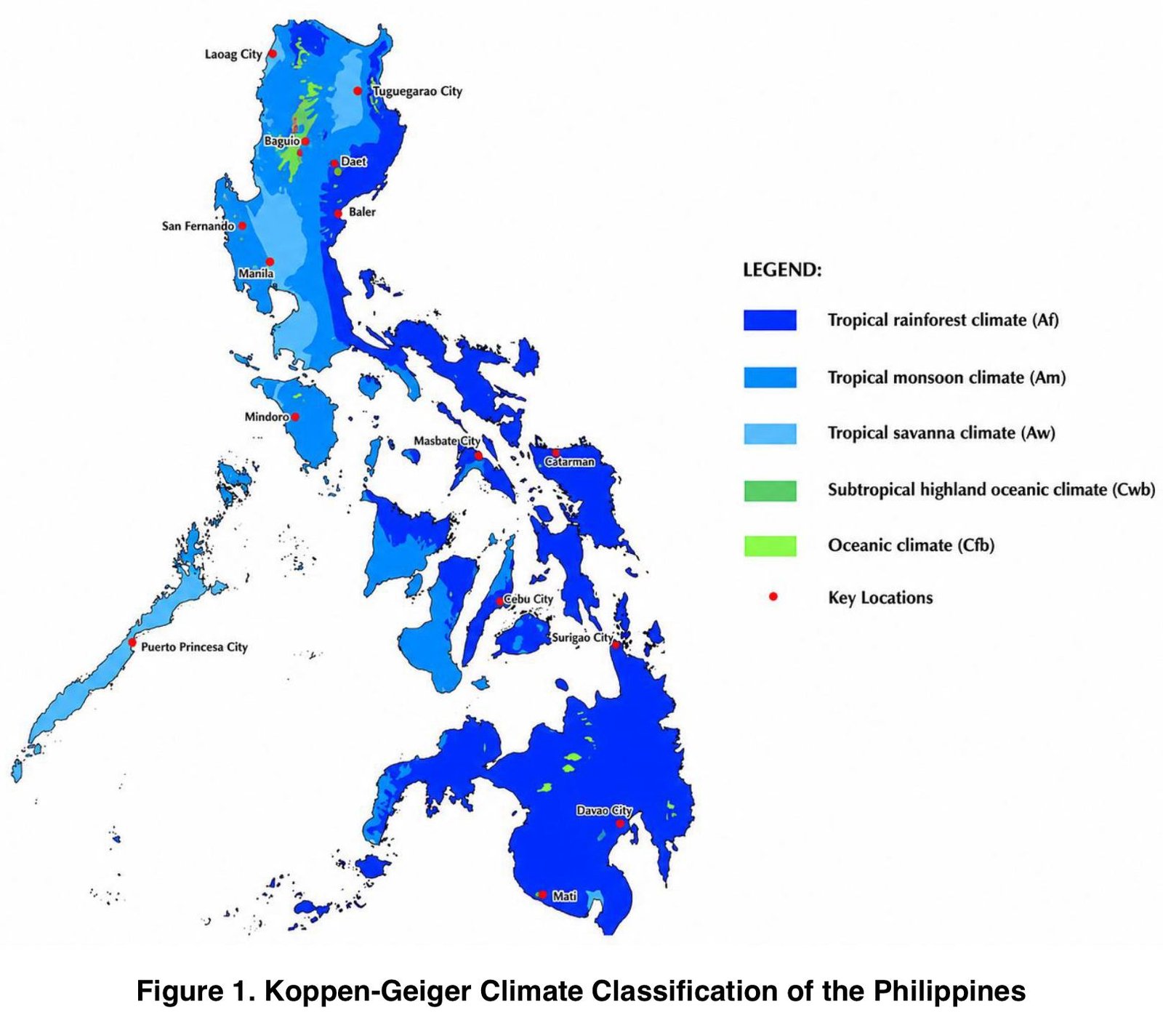
The Köppen-Geiger Classification identifies five climate categories that occur within the Philippines. Each presents unique opportunities and challenges for architectural design.
Tropical Rainforest Climate (Af)
This climate experiences abundant rainfall throughout the year with consistently warm temperatures and very high humidity. Daily weather conditions remain relatively stable, with only minor seasonal temperature variation.
Architectural priorities include maximizing natural ventilation, protecting buildings from heavy rainfall, minimizing solar heat gain, and providing effective moisture management.
Typical locations include much of Eastern Visayas, Bicol, Davao Region, and numerous coastal provinces.
Tropical Monsoon Climate (Am)
The Tropical Monsoon climate is characterized by abundant rainfall concentrated during several months of the year, followed by a relatively short dry season.
Buildings designed for this climate require effective stormwater management, generous roof overhangs, durable exterior materials, and passive cooling strategies that remain effective during both wet and dry seasons.
This climate occurs throughout many parts of Central Luzon, Southern Luzon, Western Visayas, and portions of Mindanao.
Tropical Savanna Climate (Aw)
Areas classified as Tropical Savanna experience a pronounced dry season combined with a wet summer period.
Architectural responses often prioritize solar protection, water conservation, passive cooling, landscape planning, and careful orientation to reduce cooling loads during prolonged dry conditions.
Examples include Metro Manila, Pangasinan, Tuguegarao, Puerto Princesa, and General Santos.
Subtropical Highland Climate (Cwb)
This climate occurs primarily in elevated mountainous regions where temperatures remain significantly cooler throughout the year.
Buildings located within these areas generally require less cooling but greater attention to moisture protection, wind exposure, and thermal comfort during cooler evenings.
Examples include Baguio City, La Trinidad, Sagada, and portions of Nueva Vizcaya.
Oceanic Climate (Cfb)
The Oceanic climate is the least common classification found in the Philippines and occurs only in limited high-elevation locations.
Temperatures remain mild throughout the year, with relatively uniform rainfall and moderate humidity.
Although uncommon, these locations demonstrate how elevation alone can substantially modify tropical climatic conditions and require architectural responses different from those used in lowland tropical environments.
5. Architectural Design Implications
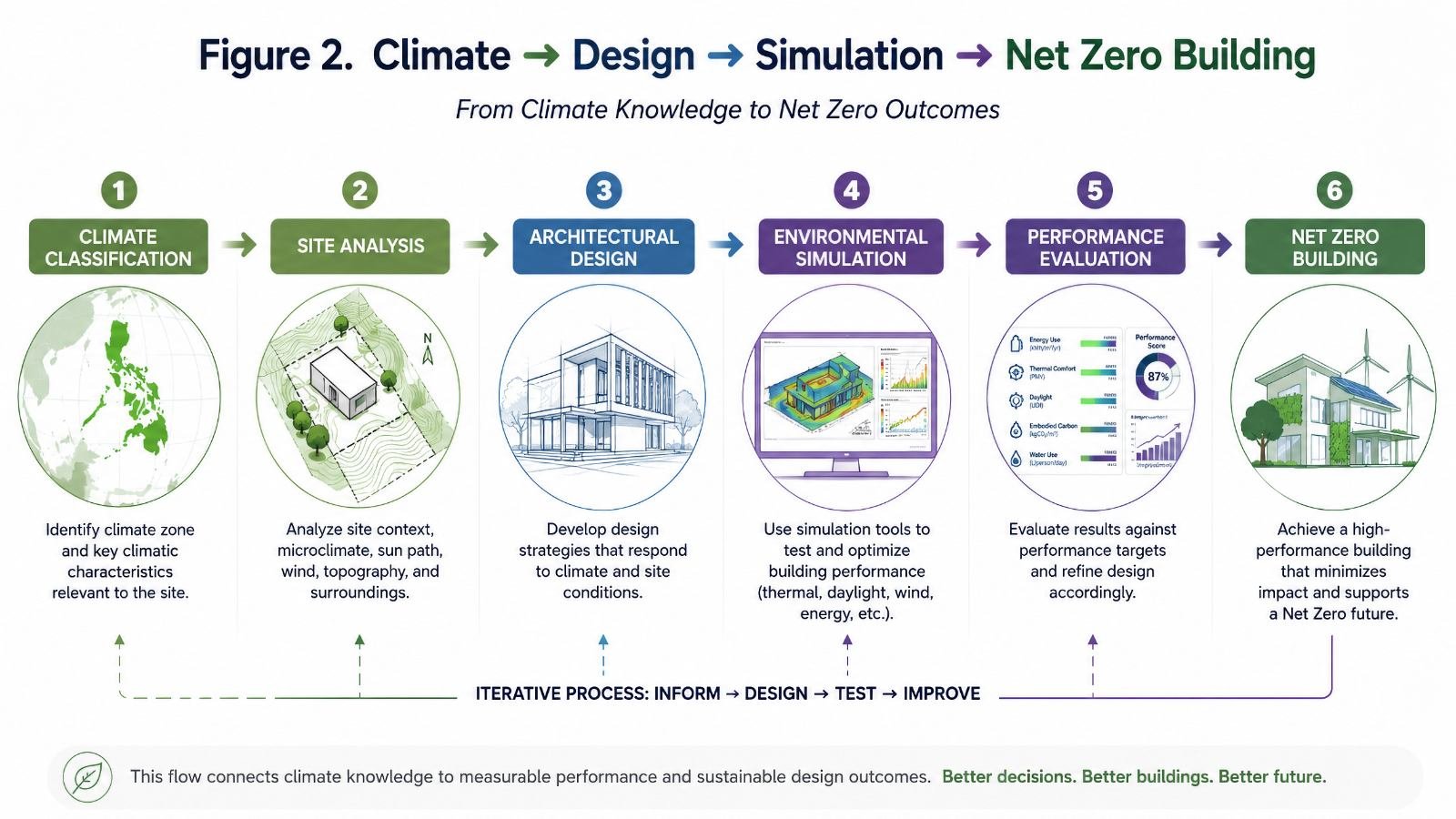
Climate classification is valuable only when it influences design decisions. Once the climatic characteristics of a project site have been identified, architects can develop design strategies that respond directly to local environmental conditions rather than relying on generalized assumptions.
In tropical climates, reducing solar heat gain and encouraging natural ventilation are often more effective than relying exclusively on mechanical air-conditioning. Conversely, buildings located in cooler highland regions may prioritize solar access and thermal retention while still providing adequate ventilation.
Among the design decisions influenced by climate classification are:
- Building orientation
- Natural ventilation strategies
- Window placement and glazing
- Roof configuration and overhangs
- External shading devices
- Material selection
- Thermal insulation
- Rainwater management
- Landscape planning
These decisions collectively influence occupant comfort, operational energy consumption, and long-term building performance.
Rather than prescribing a single architectural style, climate-responsive design encourages solutions that respond appropriately to each project's environmental conditions.
6. Regional Climate Distribution
Although the Köppen-Geiger system classifies climates scientifically, architects typically think in terms of regions rather than climate codes alone. Understanding regional climatic tendencies enables designers to anticipate common environmental conditions before detailed site investigations begin.
The Cordillera Administrative Region, for example, exhibits cooler temperatures due to elevation, while much of Metro Manila and Central Luzon experience pronounced dry seasons with high solar exposure. Eastern Visayas and the Bicol Region receive substantially greater annual rainfall because of their exposure to Pacific weather systems, whereas portions of western Luzon experience more distinct wet and dry seasons associated with the southwest monsoon.
These regional differences influence numerous architectural considerations, including roof design, moisture protection, façade detailing, ventilation strategies, and structural resilience.
Although local weather data should always be consulted during project development, regional climate classification provides an essential starting point for environmentally responsive design.
7. Using Climate Data in Design
Climate information should influence every stage of the architectural design process rather than being consulted only after a design has already been developed.
During site planning, climate data assists in determining building orientation, outdoor spaces, and landscape design. During schematic design, it informs massing studies, daylight penetration, shading strategies, and natural ventilation. As the project progresses into detailed design, climate data becomes an important input for environmental simulation, energy modelling, and building performance evaluation.
Environmental simulation software introduced in earlier publications within this Research Series—including Ecotect, Radiance, DaySim, Climate Consultant, and EnergyPlus—uses climate data as one of its primary analytical inputs. Accurate weather information therefore serves as the foundation for meaningful simulation results.
Climate classification should therefore be regarded as the beginning of environmental analysis rather than its conclusion.
8. Limitations and Practical Considerations
Although the Köppen-Geiger Climate Classification provides an excellent overview of regional climatic conditions, it should not be interpreted as a substitute for detailed environmental analysis.
Every project site possesses unique characteristics that may differ significantly from regional averages. Surrounding buildings, vegetation, topography, elevation, local wind patterns, and urban heat island effects can all influence actual environmental performance.
For this reason, architects should supplement climate classification with additional analytical tools such as:
- Site-specific weather files
- Wind rose analysis
- Solar path studies
- Daylight simulation
- Building energy modelling
- Computational fluid dynamics (CFD), where appropriate
Climate classification establishes the environmental context, while detailed simulation refines design decisions throughout project development.
9. Lessons for Philippine Practice
One of the most common mistakes in architectural practice is the widespread replication of building designs without considering climatic differences between project locations.
A residential design that performs well in Baguio City may be entirely unsuitable for Cebu, Davao, or Metro Manila. Likewise, passive cooling strategies appropriate for Palawan may require significant modification when applied to Northern Luzon or Eastern Visayas.
Climate-responsive architecture encourages architects to begin each project with an understanding of place. Rather than pursuing a universal architectural solution, designers should seek solutions that respond specifically to local environmental conditions.
This philosophy not only improves occupant comfort but also reduces operational energy consumption, enhances long-term durability, and supports the broader objectives of sustainable and Net Zero Building design.
For Philippine architects, understanding climate should therefore become as fundamental as understanding structure, planning, and construction technology.
10. Conclusion
Climate influences every aspect of building performance. From orientation and daylighting to ventilation, moisture control, and energy consumption, the environmental conditions of a site shape the success of architectural design long before construction begins.
The Köppen-Geiger Climate Classification provides architects with a practical framework for understanding these environmental differences across the Philippine archipelago. While it cannot replace detailed environmental analysis, it establishes the scientific foundation upon which climate-responsive design decisions can be made.
As buildings move toward higher levels of sustainability and Net Zero performance, climate should no longer be regarded as background information. It is one of the primary design parameters that shapes building performance from the very beginning of every architectural project.
References
-
Peel, M. C., Finlayson, B. L., & McMahon, T. A. (2007).
Updated World Map of the Köppen-Geiger Climate Classification.
Hydrology and Earth System Sciences.
Provides the internationally recognized updated Köppen-Geiger climate classification system adopted throughout this publication. -
Szokolay, S. V. (2014).
Introduction to Architectural Science: The Basis of Sustainable
Design
(3rd ed.). Routledge.
Provides the scientific relationship between climate, thermal comfort, solar geometry, and architectural design that underpins climate-responsive building practice. -
Köppen, W. Climatology: A Study of Climates of the Earth.
Introduced the original climate classification system that became the basis of the modern Köppen-Geiger climate classification. -
Philippine Atmospheric, Geophysical and Astronomical Services Administration
(PAGASA). Climate of the Philippines.
Official reference for Philippine climate data, rainfall distribution, monsoon systems, typhoon patterns, and regional weather characteristics. -
Brown, G. Z., & DeKay, M. (2014).
Sun, Wind & Light: Architectural Design Strategies (3rd ed.).
John Wiley & Sons.
Provides practical climate-responsive architectural strategies directly applicable to Philippine environmental conditions. -
Olgyay, V. (1963).
Design With Climate: Bioclimatic Approach to Architectural
Regionalism.
Princeton University Press.
Classic architectural reference demonstrating the relationship between climate analysis and passive environmental design. -
Philippine Green Building Council (PhilGBC).
Advancing Net Zero (ANZ) Philippines Framework.
Demonstrates the importance of climate-responsive design as a foundation for high-performance and Net Zero Buildings.
Suggested Citation
If you wish to reference this publication, please cite it as:
Chan, R. G. (2026). Climate Classification: Philippines. QuidErgo Research Series (QRS-050). RG Chan & Associates. https://quidergo.com/
Available Download
The original publication associated with this research paper is available for download below. It forms part of the historical Net Zero Buildings (NZB) research archive upon which the QuidErgo Research Series is based.
Original Net Zero Buildings (NZB) research paper presenting the Köppen–Geiger climate classification of the Philippines, providing the climatic foundation for the climate-responsive architectural strategies discussed in this publication.
A Note on Sources
This publication combines internationally recognized climatological references with original architectural research developed by RG Chan & Associates. While internationally accepted climate classification systems provide the scientific foundation, the climatic interpretations, environmental analyses, and architectural design recommendations presented herein represent the author's professional application of these principles to Philippine environmental conditions and climate-responsive architectural practice.
Continue Exploring
Next Publication:
QRS-060 →Climate Classification: Key Locations
Explore the climatic characteristics of major Philippine cities and regions, and understand how local environmental conditions influence climate-responsive architectural planning, passive design strategies, and sustainable building performance.